Flexible Financing Solutions for Automation-Driven Organizations
Industrial automation and robotics systems are increasingly central to manufacturing, logistics, and regulated production environments. As organizations invest in precision, throughput, and labor efficiency, automation projects must be balanced against capital planning and operational liquidity.
Industrial automation and robotics equipment financing provides organizations with structured access to robotic systems, automated machinery, and supporting technologies without large upfront capital expenditures. Financing structures such as leases or loans spread costs over time while enabling earlier deployment of automation. This approach is commonly used by organizations implementing automation within active production environments and long-term operational strategies.
Industrial automation projects are capital-intensive and often deployed in phases. Financing enables organizations to implement automation sooner while managing financial risk.
Common reasons include:
Accelerating return on investment by deploying automation earlier
Preserving working capital for inventory, labor, or expansion
Aligning payments with production output or contract milestones
Maintaining flexibility as automation technology evolves
Financing supports automation as an ongoing operational capability rather than a one-time capital event.
NFS Capital structures industrial automation and robotics financing based on how projects are implemented in real production environments. Automation deployments often involve phased timelines, multiple vendors, and integration complexity that traditional lenders struggle to evaluate.
This structure allows automation projects to move forward without being constrained by conventional credit models.
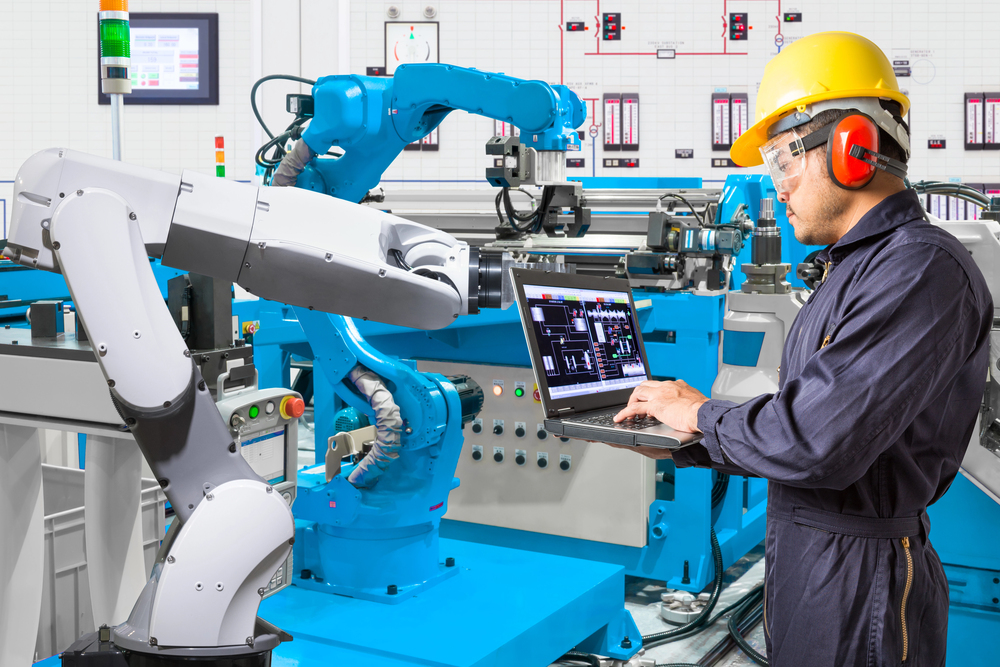
Robots and Robotic Cells
Articulated robots, selective compliance assembly robot arm (SCARA) robots, delta robots, and collaborative robots used for assembly, welding, packaging, and material handling.
Material Handling and Conveyance Systems
Conveyors, sortation systems, automated guided vehicles (AGVs), autonomous mobile robots (AMRs), and automated storage and retrieval systems (AS/RS) used in manufacturing and logistics environments.
Control Systems and Motion Equipment
Programmable logic controllers (PLCs), human-machine interfaces (HMIs), servo drives, motor controls, and automation hardware supporting precision and safety.
Machine Vision and Inspection Systems
Optical inspection systems, sensors, cameras, and AI-enabled quality control technologies.
Integration, Retrofits, and Soft Costs
Programming, installation, safety systems, guarding, and qualified integration expenses that may be included within a single financing structure.
Manufacturers ranging from mid-market facilities to enterprise-scale operations implementing automation to increase throughput, quality, and consistency.
Operators deploying automation to improve fulfillment speed, accuracy, and labor efficiency.
Organizations using precision automation to meet regulatory, quality, and cleanroom requirements.
System integrators and technology firms financing equipment for large customer deployments or internal test environments.
Businesses modernizing operations while managing liquidity constraints.
Automation initiatives demand coordination, integration, and disciplined execution across complex systems. Capital should support that complexity and align with phased deployment and long-term operational performance, enabling progress with confidence.
– Eric Renaud, Chief Credit Officer, NFS Capital
Equipment Leases
Predictable payments with flexible end-of-term options for upgrades or ownership.
Secured Loans
Asset-backed financing for organizations pursuing long-term ownership.
Up to 100% Project Financing
Single-structure financing that may include equipment, installation, and integration costs.
Custom End-of-Term Options
Purchase, renewal, or upgrade paths aligned with technology lifecycle planning.
Industry: Advanced Manufacturing
A mid-sized manufacturing company sought to automate a precision assembly process to meet rising production demand and reduce quality variance across shifts. The project involved multiple robotic work cells, integrated conveyor systems, PLC controls, and machine vision inspection equipment sourced from several vendors.
The company required a financing structure that could accommodate phased deployment, integration costs, and milestone-based vendor payments without disrupting working capital. NFS Capital structured an industrial automation equipment financing solution that bundled equipment, installation, and qualified integration costs into a single financing program, with funding released in alignment with project timelines.
Following implementation, the manufacturer reduced cycle time by approximately 25% and improved output consistency across production runs. The financing structure allowed the company to preserve liquidity for materials and labor while scaling automation in line with operational growth.
This example reflects the structure of automation projects that NFS Capital typically finances within advanced manufacturing environments.
Companies across manufacturing, logistics, life sciences, and technology sectors may qualify, including growth-stage and project-based businesses.
Terms commonly range from 12 to 84 months, depending on asset type and project scope.
Financing structures can be aligned with milestone-based implementation timelines, allowing funding to be deployed in stages as equipment is delivered, integrated, and commissioned.
In many cases, qualified soft costs may be bundled into a single financing structure.
Automation financing typically begins with a review of the project scope, including equipment specifications, vendor relationships, deployment timelines, and expected operational impact.
Underwriting evaluates not only financial statements but also production goals, integration complexity, and milestone-based implementation schedules.
Funding is coordinated to align with vendor payments, system integration, and commissioning milestones, supporting deployment without disrupting working capital.

Organizations considering automation financing typically begin by defining project scope, equipment requirements, and deployment milestones. Financing structures can then be aligned with production timelines, integration schedules, and long-term operational strategy.
For more information about NFS Capital’s industrial automation and robotics equipment financing, contact us today.